

Archaeologists have made an extraordinary discovery inside the ancient mud metropolis of Chan Chan. Excavation teams uncovered a monumental Chan Chan elite funerary platform that remained completely sealed for six centuries. The structure stands in the Utzh An Walled Complex, historically known as the Gran Chimú Palace. The discovery shatters a long history of looting across the Moche Valley. It provides an intact view into the dynastic rituals of the Chimor Kingdom.
Tripartite Architecture and Mortuary Layout
The adobe platform measures 17 meters on each side and reaches five meters in height. The Chan Chan Archaeological Complex Special Project (PECACH) directed the two-million-sol excavation during its eighth season. The internal layout features three distinct functional areas:
- The Central Chamber: Reached via a mud staircase descending 2.5 meters, this room held the paramount lord, surrounded by marine shells and precious metal regalia.
- Lateral Chamber 1 (Martial Armory): This long room contained no human bones. It served exclusively to store arsenals of bronze weapons, star-shaped maces, and ceremonial spears.
- Lateral Chamber 2 (Elite Retinue): This section held 20 carefully arranged individuals, with 18 more placed in adjacent structural niches to complete the 38 interred bodies.
This intact spatial hierarchy mirrors the historical significance of other recent northern finds, including the Wancasanga archaeological find documented in Cajamarca earlier this season.
Postural Anomaly and the Ancestor Cult
The central figure breaks standard Chimú mortuary customs. Traditional burials placed bodies in seated flexed bundles. In contrast, this paramount noble lay extended on his back on the chamber floor. Bioarchaeologist Jorge Meneses Bartra suggested this posture denotes an elite dynastic marker or a distinct foreign lineage.
Furthermore, parts of the individual’s torso and limbs were intentionally removed in antiquity. Rather than vandalism, this reflects the Andean veneration of mallquis (ancestor mummies). Families frequently retrieved sacred bones to serve as protective relics during public ceremonies before permanently sealing the tomb.
Material Prestige and Chimú-Inca Interaction
The grave goods demonstrate vast wealth and interregional trade:
- Crown headpieces, ear spools, and pectorals forged in gilded copper, silver, and gold.
- Sacred Spondylus princeps shells transported from warm Ecuadorian waters.
- Carved wooden storage boxes containing delicate textiles and cinnabar pigment.
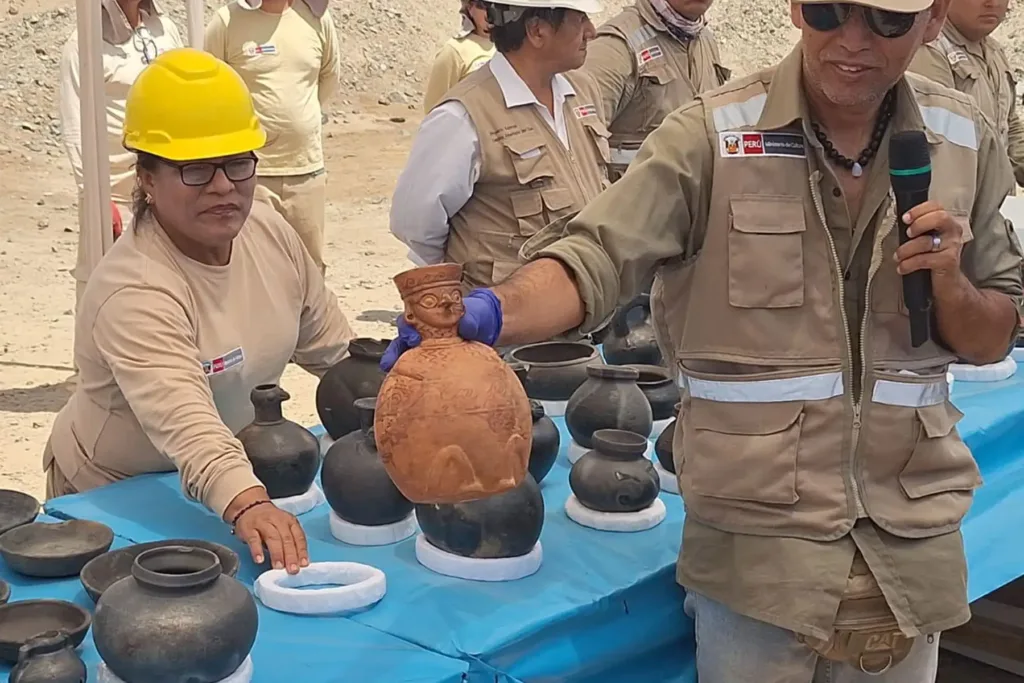
- Over 60 complete ceramic vessels featuring red paste and early Inca aryballos shapes.
The presence of Inca-influenced ceramics confirms the tomb dates to the late 15th century. This coincides with the reign of Minchancaman and the conquest led by Túpac Inca Yupanqui. PECACH teams employed 3D digital photogrammetry and chemical field stabilization to document every artifact before laboratory transport. This ensures precise radiocarbon and ancient DNA testing for upcoming scientific monographs.
Leave a Reply