
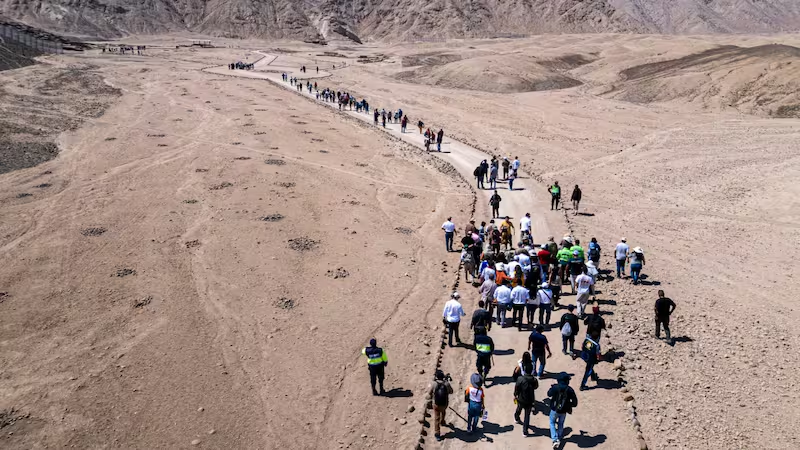

Archaeologists recently confirmed an extraordinary discovery on Peru’s northern coast. Located in the Casma Valley, the ancient city of Peñico features monumental stone temples. In addition, the site contains expansive public plazas and sacred ritual artifacts. Researchers from the Universidad de San Marcos documented the remarkable findings. Consequently, the team published their research in the Encyclopedia of Global Archaeology. This ancient settlement now ranks among the earliest planned cities across the Americas.
Monumental Temples and Ceremonial Assemblages
Field teams concentrated their initial excavations on an architectural complex labeled B1-B3. Inside these monumental enclosures, researchers recovered unbaked clay sculptures. Furthermore, they found carved shell trumpets, known locally as pututus. The team also uncovered various ceremonial stone tools. Therefore, these artifacts demonstrate an active ritual life within the community. Sacred music and shared symbols clearly strengthened social cohesion among the residents.
Additionally, archaeologists identified dedicated storage sectors and communal processing facilities. These structures point to complex social coordination and administrative control. As a result, ancient authorities easily managed the redistribution of food and local resources. This discovery shares close chronological links with the Vichama archaeological discoveries. Both coastal settlements developed sophisticated architecture during this transformative era.
Transforming the History of Early American Urbanism
The ancient city of Peñico belongs to a dense network of early settlements. For example, it neighbors famous Casma Valley complexes like Sechín Bajo and Sechín Alto. However, Peñico stands out because of its unique urban design. The city directly integrates residential zones with sacred civic spaces.
Moreover, builders enclosed circular plazas within thick stone walls. Families lived in domestic compounds placed right next to these communal courtyards. Thus, this design represents an early model of intentional urban planning in South America. In fact, it predates cultures like the Moche and the Inca by thousands of years.
Consequently, the site reinforces the status of the Central Andes as an independent cradle of civilization. This culture developed complex urban centers alongside ancient Mesopotamia and Egypt. Finally, Peruvian authorities announced protective frameworks to preserve the ruins. They plan to open the area gradually to archaeological tourism in upcoming stages.
Leave a Reply