
Peru’s Ministry of Culture announced a major Peñico archaeological discovery in the Huaura province of the Lima region. Researchers unearthed a ritual offering dating back approximately 3,800 years. This collection of wooden and bone objects highlights the site’s role as a center of power and ritual following the decline of early American civilizations.
The find delivers fresh evidence regarding cultural continuity in the Supe Valley after the original urban centers of the Caral civilization (3000 – 1800 B.C.) were abandoned.
Highly Symbolic Carved Objects
A team of investigators from the Caral Archaeological Zone, led by Dr. Ruth Shady Solís, identified this unique cache. Ancient builders carefully placed the offering during a ritual linked to the construction of a new platform within the settlement’s Main Public Building.
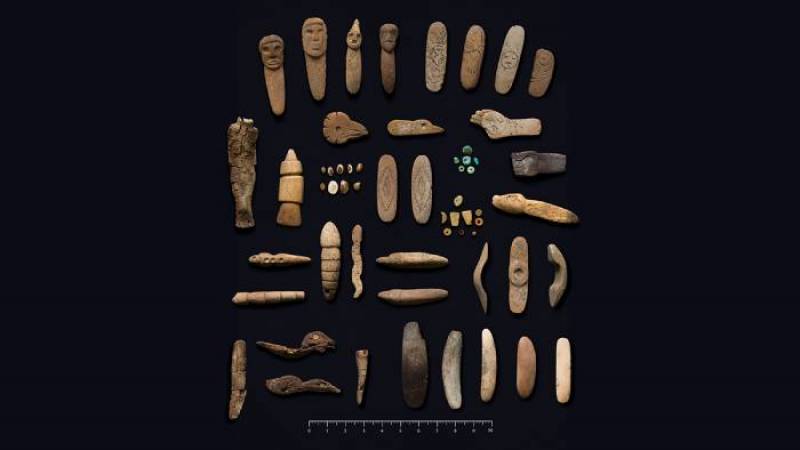
The offering contains 43 individual items crafted from wood and bone. Many feature engraved designs, and some show signs of fire exposure. The pieces depict mythical characters, human-like shapes—including a female figure and likely authority figures—alongside animal representations like birds, snakes, and tadpoles. Geometric and abstract patterns also appear on the artifacts.
Several items contain small hollows made specifically to hold minerals or semi-precious stones, emphasizing their ceremonial use. The team also recovered three chrysocolla beads and fragments, two pieces of terrestrial snail shell beads, nine eyes made of mollusk shells meant for sculptures, and eight smaller objects currently under study.
Proof of Cultural Continuity
Excavators located the offering inside a compact 22-centimeter space bordered by rounded river stones arranged in a semicircle. A large, heavy rock covered the entire structure. This specific archaeological layout represents a clearly planned ceremonial act holding deep symbolic weight for the Peñico society.
This Peñico archaeological discovery extends beyond academic circles. It serves as an exceptional record of a society that sustained a cultural tradition originating in the Supe Valley. These people helped pass down foundational knowledge to subsequent Andean societies. The evidence from Peñico shows that the beliefs, memories, and skills of the earlier Caral population survived, evolved, and found new cultural expressions even after the ancient cities fell.
Peñico’s Enduring Heritage
Founders established the urban center of Peñico around 1800 B.C., covering an archaeological area of 19.44 hectares. This occurred after the oldest Caral urban centers, including the Sacred City of Caral-Supe located 12.93 kilometers away, lost their prestige.
Research indicates that Peñico did not represent a cultural break. Instead, builders designed the city—which houses 15 public buildings—as a hub connecting the coast and the highlands. Goods from the jungle even reached this location. The city preserved and adapted the organizational structures and ceremonial practices inherited from the Caral tradition that blossomed centuries earlier in the same valley.
The recently uncovered offering proves this historical link. Specialists noted clear similarities in the raw materials, carving techniques, and iconographic patterns found on the recovered pieces. Archaeological analysis also confirms that ancient residents deposited the cache during the initial building phases of the Main Public Building to consecrate important architectural spaces.
Upcoming Peñico Raymi Celebration
Following nine years of dedicated research and conservation efforts to restore the site, the Caral Archaeological Zone will host the second Peñico Raymi. This traditional Andean festival takes place on Saturday, July 11, 2026, starting at 10:00 a.m. Admission is completely free.
The schedule features a variety of cultural activities. Attendees will witness a traditional payment ceremony to the Earth (Pachamama), a public recognition of the local community for protecting their cultural heritage, and a lively artistic festival.