
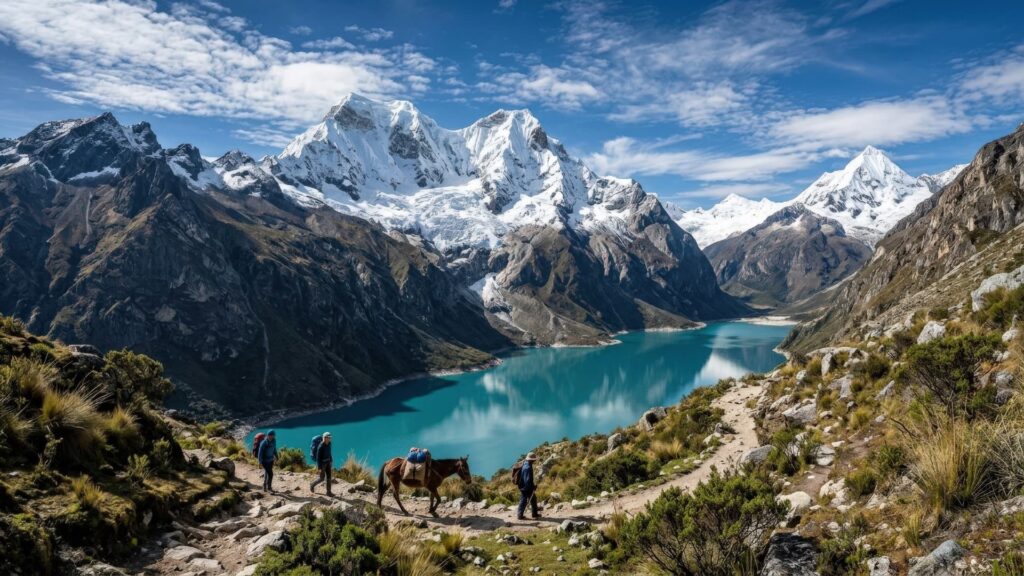

The recent national holidays brought a massive wave of domestic travelers to the northern Andes. Official reports confirm that Huascaran National Park tourism reached exactly 20,427 visitors between July 25 and July 29, 2026. This impressive attendance easily surpasses the 19,150 people registered during the same period last year. It even breaks the pre-pandemic records from 2019, when 20,165 individuals entered the protected area.
Domestic Demand Driving Huascaran National Park Tourism
This 7% annual increase solidifies the Ancash region as a premier destination for nature lovers. The peak days occurred between July 26 and July 28, accounting for 15,101 entries, which equals 74% of the total influx. July 28 alone recorded 5,519 entries as families took advantage of the central holiday.
The visitor profile shows a heavy preference from domestic travelers. About 80% of the total entries came from Peruvians traveling from other regions. Local residents made up 15%, while foreign tourists accounted for only 5%. This distribution highlights a growing internal demand for high-mountain destinations, similar to the surge seen in Piura Fiestas Patrias tourism along the northern coast.
Top Sectors for Adventure and Sightseeing
The Llanganuco sector led the statistics once again, receiving 14,593 visitors. This area sits directly between the Huascaran and Huandoy snow-capped peaks. Travelers flock here to see the turquoise waters of the Chinancocha and Orconcocha lagoons. They enjoy boat rides, hiking, and wildlife observation surrounded by native forests.
The Ulta sector secured second place with 4,351 entries. It serves as a primary access point for adventure routes and glacier lagoons. Meanwhile, smaller sectors experienced massive percentage jumps. Llaca grew by 16%, and Purhuay skyrocketed by over 180%, jumping from 173 to 487 visitors compared to the previous year.
Promoting Sustainable Management
The National Service of Natural Protected Areas (SERNANP) emphasized that these numbers reflect a strong recovery for the region. However, high attendance requires strict management. Authorities plan to continue implementing environmental awareness campaigns to promote responsible travel. The main objective involves preserving the delicate mountain ecosystems while supporting local communities that depend on these activities.
With 340,000 hectares available for trekking, climbing, and mountain biking, the reserve proves that the southern circuits are not the only options for travelers. Just as the Cusco South America best city award attracts global crowds, the Ancash mountains are successfully capturing the domestic market through sustainable Huascaran National Park tourism.

Leave a Reply