
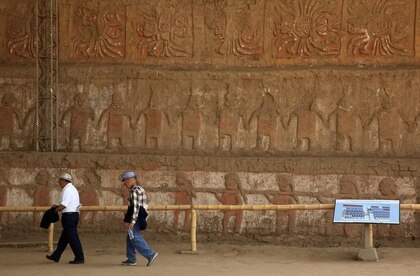

Recent Pacatnamu archaeological discoveries in the Jequetepeque Valley are changing what we know about ancient Peruvian history. A joint Peruvian-Canadian team found hard evidence of ritual banquets and a sacred fruit linked to the Moche and Lambayeque cultures. These findings offer fresh details about religious ceremonies at one of the most significant pre-Hispanic oracles on the northern coast.
Ritual Banquets and Traveling Pilgrims
During their first week of excavations at Huaca 34, the team uncovered a designated area for food preparation and consumption. Carito Tavera Medina, co-director of the project, explained that they recovered remains of cherimoya, lucuma, marine mollusks, fish, and camelid bones.
Interestingly, many of these ingredients came from completely different ecological zones rather than the immediate valley. This specific mix proves that pilgrims traveled from various regions, bringing external resources for collective religious ceremonies. Therefore, the Pacatnamu archaeological discoveries strongly support the theory that this site operated as a massive pilgrimage center in the Andean world. Understanding this deep-rooted heritage helps explain modern cultural initiatives, similar to the recent Peru brand campaign that highlights national identity.
Unearthing the Sacred Ulluchu Fruit
One of the most surprising finds was an intact specimen of the ulluchu fruit. Historically, Moche iconography heavily features this plant in religious contexts. Researchers believe ancient priests used the fruit to prevent blood coagulation during sacrifices, a practice famously depicted in the “Priestess of the Goblet” ceramic scenes.
While the current campaign has not yet revealed large ceremonial offerings, finding the ulluchu directly connects the site to coastal religious rituals. Additionally, the team recovered ceramic fragments featuring shapes and decorative styles never seen before in the valley. Professor Edward Swenson from the University of Toronto noted that these ceramic styles are entirely new to the region’s historical record, opening new research paths regarding ancient cultural interactions.
Digital Archaeology and Site Preservation
Alongside traditional digging, the project uses digital archaeology tools led by Professor Giles Spence Morrow from McMaster University. By comparing historical photographs with modern digital records, the team can precisely identify areas damaged by recent looting.
Protecting this heritage is a major priority right now. Just a month ago, archaeologist Walter Alva warned about increased looting at the site. Criminals actively destroy adobe architecture, scatter textiles, and ruin irreplaceable scientific data. As the team plans at least four more research seasons, these ongoing Pacatnamu archaeological discoveries will help authorities develop better conservation strategies for this massive northern ceremonial center.

Leave a Reply