
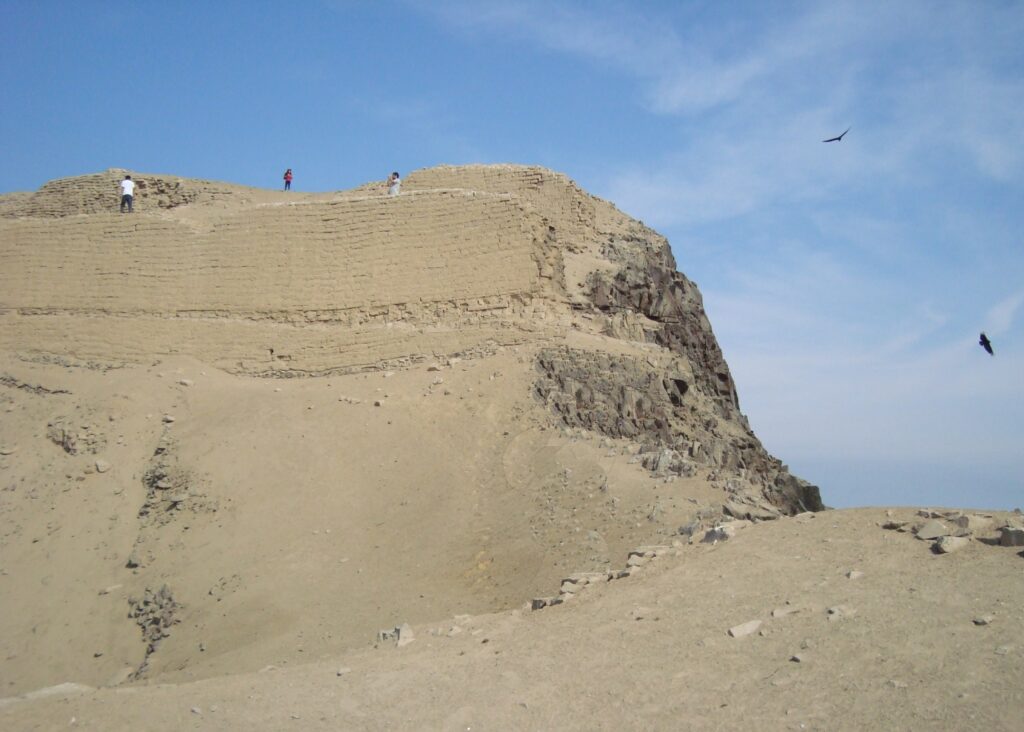

Recent excavations in the Barranca province uncovered a massive complex of stone and adobe platforms, defensive walls, and ceremonial plazas. The Cerro de la Horca archaeological find strengthens the theory that this location served as a major political and religious hub in the lower Fortaleza valley between 900 and 1400 A.D.
José Luis Fuentes, lead researcher and archaeologist from the National University of San Marcos, explained that this settlement is incredibly complex. The area contains nearly 20 distinct mounds surrounding four main plazas, connected by internal pathways that have no comparison in this specific region of the coastal valley.
Uncovering a Regional Sanctuary
The current investigation suggests the complex operated as a sanctuary dedicated to a regional deity, closely tied to ancient coastal religious traditions. At the top of the main hill, which stands 90 meters tall, three platforms face a steep cliff overlooking the Fortaleza river mouth. Historically, travelers recorded local legends claiming that Chimu and Inca leaders executed people by throwing them off this exact cliff. This dark history likely gave the site its name, which translates directly to “Hangman’s Hill.”
Historical records strongly support this religious theory. In the 1930s, French researcher Louis Langlois discovered a 1.20-meter wooden idol at this location. The carved figure featured iconography linked to the Pativilca culture, suggesting the area housed an important regional deity similar to the Pachacamac cult. If you enjoy reading about coastal religious sites, you can compare this layout with the recent San Isidro archaeological find discovered during urban excavations in the capital.
Architectural Phases and Cultural Expansion
During the last two months of digging, the team identified at least two major construction phases. The older structures consist of carved river stones built during the Late Middle Horizon by the Pativilca culture. Later on, Inca populations completely remodeled the area using adobe bricks during the Late Horizon. This physical evidence partially confirms accounts from 19th-century traveler Charles Wiener, who originally noted multiple building phases at the site.
Researchers recovered numerous ceramic fragments, textiles, and botanical remains belonging to the Pativilca, Casma, and Huaura societies. Fuentes noted that the Casma culture likely occupied the valley between 1100 and 1300 A.D., right before the Chimu expansion. Furthermore, the large mounds in the lower sector likely served as residential zones for priests and elite groups managing the hilltop sanctuary.
While the current excavation project operates with limited private and municipal support, experts agree that the site holds immense scientific value. Expanding these research efforts will eventually transform the complex into a major tourist attraction for the Paramonga district, similar to the ongoing cultural development surrounding the Pikimachay archaeological excavations in the southern Andes.

Leave a Reply