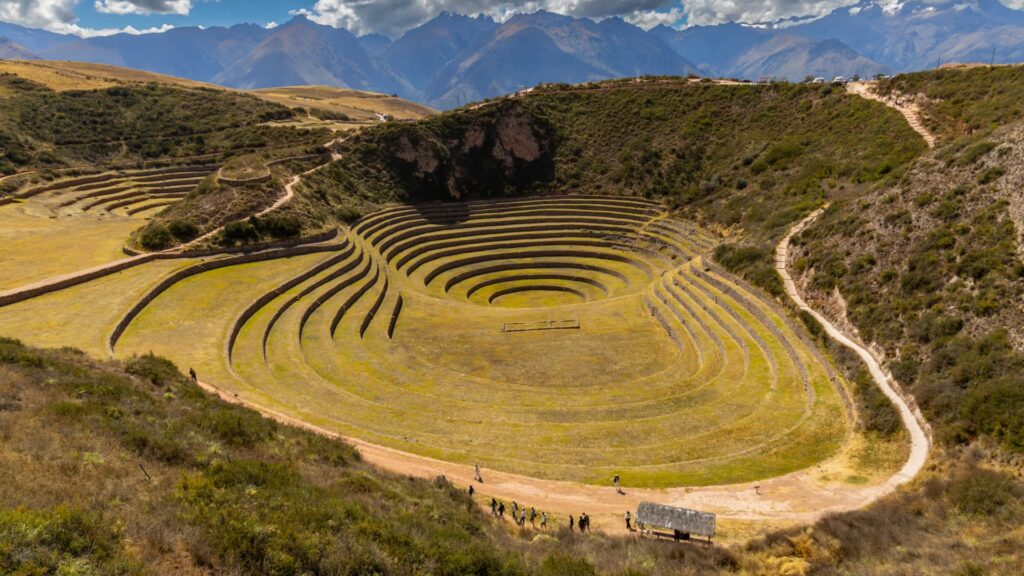

You are standing at the rim of a giant stone bowl. Below you, rings of terraces step down into the earth, each one a little narrower than the last. There is no temple, no fortress, no royal palace. Just geometry, water channels and silence.
This is the Moray terraces in Peru, and it is one of the strangest places the Incas ever built. Nobody wrote down why. Archaeologists, engineers and agronomists have been arguing about it for decades.
This guide gives you the full picture: what Moray is, the science behind its microclimates, the theories about its purpose, and the practical details you need to visit from Cusco without wasting a day.
What Is Moray Peru? A Complete Overview
Moray (Muray in Quechua) is an archaeological site on a high plateau in the Sacred Valley region. It is a group of terraced circular depressions cut into the ground, and it looks more like a modern amphitheater than an Inca ruin.
Where Moray Is Located
The site lies about 50 km northwest of Cusco, just west of the village of Maras and roughly 7 km from it. That is why the two are almost always visited together. The plateau sits at about 3,500 meters (11,500 ft), slightly higher than Cusco itself.
Moray at a Glance
| Feature | Data |
|---|---|
| Quechua name | Muray |
| Location | About 50 km northwest of Cusco, near Maras |
| Altitude | ~3,500 m (11,500 ft) |
| Largest depression | ~30 m (98 ft) deep |
| Temperature gap, top to bottom | Up to 15°C (27°F) |
| Water system | Irrigation channels, still visible today |
| Culture | Inca |
| First photographed | 1931 |
| Ticket | Cusco Tourist Ticket (BTC) |
What Makes the Moray Terraces So Unique?
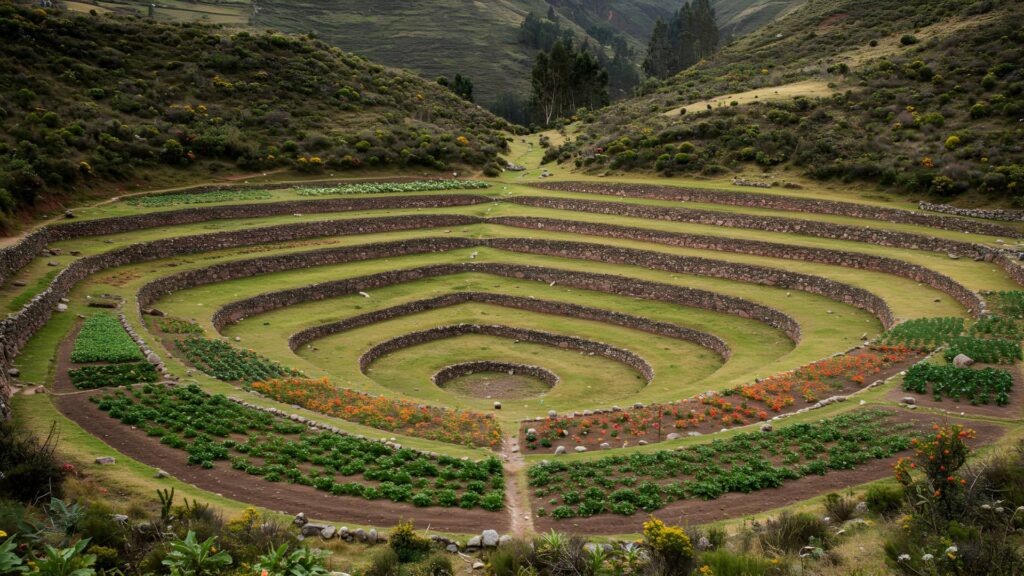
Most Inca sites were built to defend, worship or govern. Moray is different. Instead of temples or fortresses, you find concentric circular terraces carved into a natural depression. From above, they resemble a giant amphitheater, and their purpose remains one of the great enigmas of Inca engineering.
How the Site Is Built
Moray is not one bowl but several terraced depressions, and the largest is about 30 meters deep. Stone steps project from the walls at intervals, so people could climb from the top ring to the bottom without stepping on the planting surface.
Water was part of the design from the start. A system of irrigation channels fed the terraces, and the central basin is reported to drain so well that it does not stay flooded even after heavy rain.
A Site Few People Knew About Until 1931
Moray was first photographed in 1931, which is late for a site this close to Cusco. That is one reason it has far fewer written records than Machu Picchu or Sacsayhuamán.
Later, civil engineer Kenneth Wright and his team carried out a detailed study of how Moray was surveyed and how its water was collected and delivered. His work, published by the American Society of Civil Engineers, remains one of the main technical references on the site.
Was Moray an Agricultural Laboratory?
Many researchers believe Moray worked as a sophisticated agricultural lab. The Incas may have used the terraces to simulate different microclimates. This would let them test how crops like maize, quinoa and potatoes responded to changes in temperature, altitude and sunlight.
The idea is not just a romantic story. It rests on measurable facts about the site itself.
Microclimates in Stone
The depth, design and orientation of the depressions in relation to wind and sun create a temperature difference of up to 15°C between the top and the bottom. Closed basins like these also trap cold air on calm, clear nights at altitude.
This gap is close to the difference between coastal farmland and high Andean terraces about 1,000 meters above sea level. In other words, the Incas could have reproduced very different growing zones without leaving a single hillside.
Why That Matters for Crops
The Inca Empire stretched from the Pacific coast to the high Andes and into the jungle. Its people depended on crops that grew in very different conditions. Peru is still home to thousands of native potato varieties, which gives a sense of how much farming knowledge the Andes held.
Some scholars describe Moray as a center for studying how wild plants could be domesticated, acclimatized and adapted for human consumption. A site that offers many climates in one place would be ideal for that work.
Controlled Testing in One Place
Engineers who have studied the site point to a practical advantage. Testing in a single location, with one team and the same tools, gives far better control than spreading experiments across distant valleys.
Moving a planting a few feet up or down the slope changes its conditions. That makes the terraces work like an adjustable thermostat built in stone.
Soils From Across the Empire
Some studies report that soils from different regions of the empire were carried to the terraces. If this is correct, it supports the idea of a testing ground where crops from many climates were grown side by side.
How an Inca Experiment Might Have Worked
Nobody can reconstruct the exact method, but the layout suggests a simple logic:
- Bring seeds or tubers from different regions of the empire.
- Plant the same crop on several terrace levels.
- Watch how each level changes growth, harvest and survival.
- Choose the varieties and conditions that performed best.
- Spread the successful crops to the right zones of the empire.
This is a reasonable reading of the evidence, not a documented procedure.
Highlights of the Moray Inca Ruins
- The terraces: each level has its own microclimate, with differences of up to 15°C between top and bottom
- Irrigation channels: still visible today, they show how the Incas controlled water flow with precision
- The surrounding landscape: mountains and farmland frame the site with wide Sacred Valley views
Moray’s Dual Identity: Lab and Ritual Space
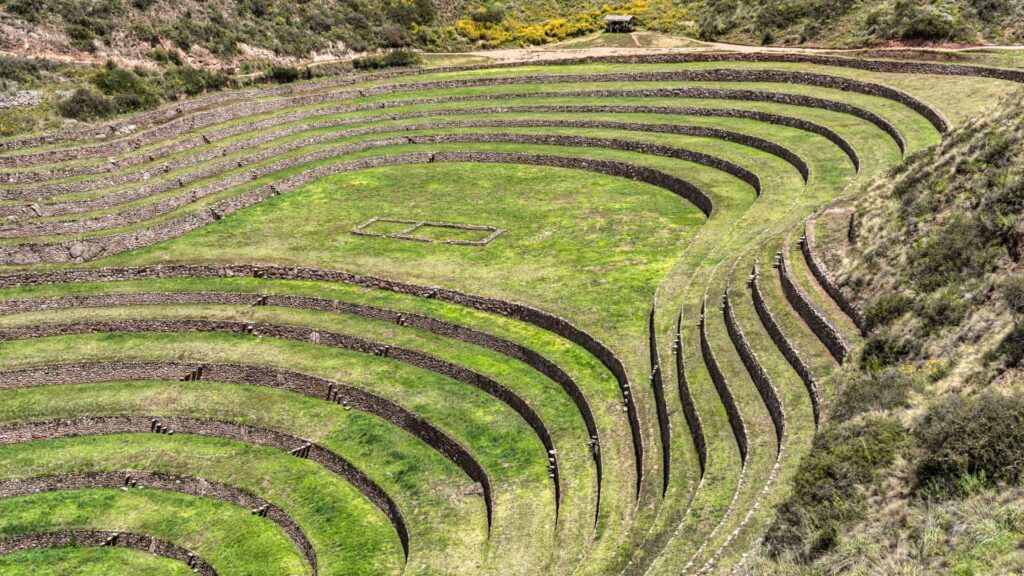
The agricultural theory is strong, but Moray’s design also points to ceremonial intent. Its symmetry, acoustics and alignment with celestial events hint at a deeper spiritual role. Some archaeologists propose that Moray was both a place of experimentation and of ritual, where science and cosmology coexisted.
The Two Main Theories Compared
| Agricultural Lab | Ceremonial Space | |
|---|---|---|
| Main idea | A testing ground for crops in many microclimates | A sacred site tied to the sun and the earth |
| Supporting evidence | Temperature gap, irrigation, imported soils | Circular symmetry, acoustics, solar alignment |
| Weak point | No written record of experiments | No written record of rituals |
| Who favors it | Engineers and agronomists | Some archaeologists |
Why the Two Ideas May Not Compete
For the Incas, planting, the sun and the sacred were connected. Agriculture followed ritual calendars, and the earth itself was treated as a living presence.
Studying the soil could have been a practical task and a spiritual one at the same time. That would explain why a working farm looks like a ceremonial space.
Was Moray Built Only by the Incas?
Some sources suggest that the lower terraces may be older than the Incas, possibly connected to the Wari culture, which lived between the 6th and 10th centuries. This is still debated, so it is best treated as a hypothesis, not settled fact.
Why We May Never Know for Sure
The Incas did not use a written language, so the site comes with no instruction manual. What survives is the stone, the water system and the temperature data.
That is also why Moray holds your attention. It invites several readings, and it suggests the Incas studied the earth not only to feed their empire, but to understand their place within it.
“Most visitors photograph Moray from the rim and move on. My advice is to walk down to the second ring, stand still for a minute, and feel how the air changes between there and the top. That is when the microclimate idea stops being theory. Take the steps slowly, because at 3,500 meters rushing is the mistake I see most often. And go early, when the site is quiet and you can hear the place.”
Senior Lead Expedition Guide, Qosqo Expeditions
How to Visit Moray From Cusco
Moray is easy to include in a Sacred Valley day, but a little planning makes a big difference. Here is what you need to know.
Getting There
Moray is about 50 km from Cusco and is reached by car, taxi or guided tour. Most visitors combine it with the Maras salt mines, which are a short drive away. Starting early helps you avoid the midday crowds.
Tickets and Entry
Moray is covered by the Cusco Tourist Ticket (BTC). Entry is not normally sold separately at the site, so arrange your ticket in advance.
| Ticket | What it covers | Validity | Foreign adult price |
|---|---|---|---|
| Partial Circuit III (Sacred Valley) | Pisac, Ollantaytambo, Chinchero, Moray | 2 days | ~S/ 70 |
| General ticket | 16 sites in Cusco and the Sacred Valley | 10 days | ~S/ 130 |
| Maras salt mines | Separate ticket | Single entry | ~S/ 20 |
- The BTC is bought in person in Cusco, with your passport.
- It cannot be bought online.
- Prices and rules change, so confirm with COSITUC shortly before you travel.
How Much Time You Need
Moray itself does not need a full day. Express Sacred Valley tours spend about 30 minutes at each stop, while classic tours stay 1 to 2 hours.
A Moray, Maras and Chinchero circuit usually takes 6 to 8 hours with hotel pickup. A bigger day that adds Ollantaytambo and Pisac can run around 12 hours.
A Sample Half-Day Route
- Leave Cusco early in the morning.
- Visit Chinchero for its weaving communities and Inca terraces.
- Continue to Moray while the site is still quiet.
- Finish at the Maras salt mines.
- Return to Cusco in the afternoon.
Altitude and Comfort
At about 3,500 m, Moray sits slightly higher than Cusco. If you have just arrived, you may feel it on the walk down into the bowl and back up.
- Spend a day or two in Cusco before a full Sacred Valley itinerary
- Drink water and walk slowly
- Wear layers, because the temperature changes through the day
- Bring sun protection, since the altitude makes the sun strong
Best Time to Go
Early morning is the calmest and gives the best light on the terraces. The dry season, roughly May to September, brings clearer skies and easier walking. During the rainy season, paths can be slippery.
Tours That Include Moray
- Extended Sacred Valley Tour: Pisac, Ollantaytambo, Moray, the Maras salt ponds and Chinchero in one day
- Biking over the Sacred Valley: reach Moray and Maras on two wheels
- Across the Amazon to the Andes: Sacred Valley highlights with immersive cultural stops
- Short Inca Trail to Machu Picchu: connects Moray’s agricultural legacy with the road to Machu Picchu
Want a route built around your dates and pace? Plan your tailor-made trip.
Frequently Asked Questions About the Moray Terraces
How high is Moray Peru?
Moray sits at about 3,500 meters (11,500 ft) above sea level on a high plateau. That is slightly higher than Cusco, so you may notice the altitude if you arrived recently.
- Altitude: ~3,500 m (11,500 ft)
- Cusco city: about 100 m lower
- Maras salt mines: close by, at similar altitude
Spend at least one night in Cusco before visiting.
Where is Moray Peru located?
Moray is in the Sacred Valley region, about 50 km northwest of Cusco. It lies just west of the village of Maras, which is why most tours visit both together.
- Distance from Cusco: ~50 km
- Distance from Maras: ~7 km
- Nearest town: Maras
Combine it with Maras and Chinchero to make the trip worthwhile.
How deep are the Moray terraces?
The largest depression at Moray is about 30 meters (98 ft) deep. The site has several terraced circular depressions, and they are not all the same size.
- Largest depression: ~30 m deep
- Layout: concentric circular terraces
- Access: stone steps built into the walls
Walk down only if you are comfortable with steps at altitude, and allow time to climb back.
How big is the temperature difference at Moray?
The temperature can differ by up to 15°C (27°F) between the top and the bottom of the terraces. This comes from the depth, the design and the orientation toward wind and sun.
- Maximum gap: ~15°C (27°F)
- Cause: depth, orientation and cold air trapped in the basin
- Meaning: different growing zones in one site
Bring layers so you are comfortable at both the rim and the bottom.
How old is Moray?
Moray is attributed to the Incas and is generally placed in the 15th century. Some researchers suggest that parts of the site may be older.
- Main builders: the Incas
- Possible earlier link: the Wari culture (6th to 10th centuries)
- Status: still debated
Ask your guide which theory they favor and why.
What were the Moray terraces used for?
Most researchers believe the terraces were used for agricultural experiments with different crops and climates. Others see a ceremonial role as well, and the two ideas may overlap.
- Main theory: an agricultural lab
- Supporting evidence: temperature gap and irrigation
- Other view: a ritual space linked to the sun
Look at the symmetry from the rim before you descend.
Do I need the Cusco Tourist Ticket to enter Moray?
Yes. Entry to Moray is normally through the Cusco Tourist Ticket (BTC), which you buy in person in Cusco with your passport.
- Partial Circuit III (Sacred Valley): ~S/ 70, valid for 2 days
- General ticket: ~S/ 130, valid for 10 days
- Maras salt mines: separate ticket, ~S/ 20
Check current prices with COSITUC before you go, since they change.
What is the best way to get to Moray?
A guided tour is the simplest option because transport and logistics are handled for you. You can also go by car or taxi from Cusco, or visit by bike on an organized tour.
- Guided tour: simplest, usually with hotel pickup
- Private car or taxi: flexible, set your own timing
- Bike tour: a more active way to reach Moray and Maras
Start early to enjoy the site before the busiest hours.
What should I combine with Moray?
The Maras salt mines are the classic pairing, only a short drive away. Chinchero, Pisac and Ollantaytambo can complete a full Sacred Valley day.
- Short route: Chinchero, Moray, Maras
- Longer route: add Ollantaytambo and Pisac
- Typical time: 6 to 8 hours for the short route
Do not try to add too many stops if you are still adjusting to the altitude.
Is Moray worth visiting?
Yes, if you are interested in engineering, agriculture or Inca history. It is quieter than Machu Picchu and unlike any other Inca site you will see.
- Best for: history, photography, curious travelers
- Time needed: from 30 minutes to 2 hours
- Pairs well with: Maras, Chinchero and a Sacred Valley day
Go with a guide if you want the stories behind the stones.